


US Fishing Goods Market: Smart Fishing Gear and Outdoor Recreation Drive Growth to 2034

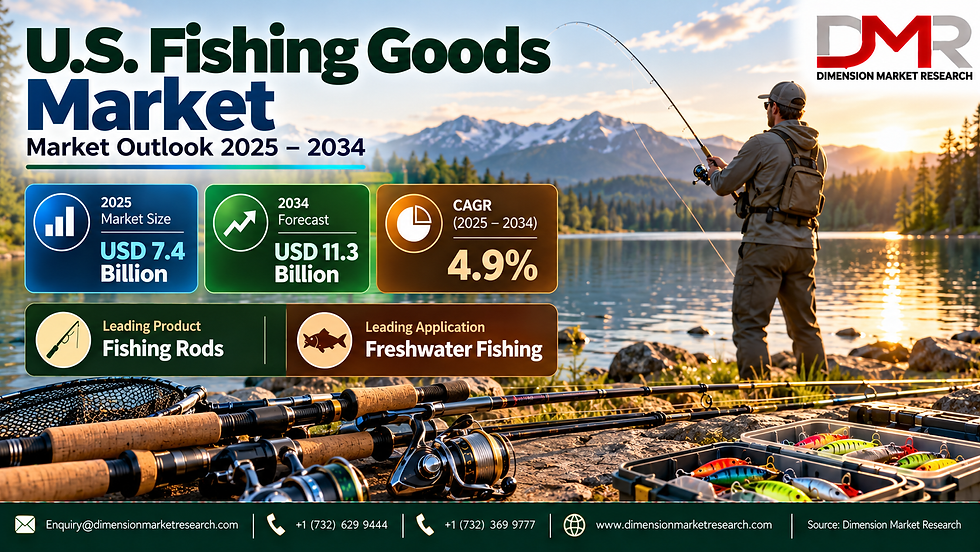
The US Fishing Goods Market is experiencing steady growth as recreational fishing, outdoor tourism, and technological innovation influence consumer demand for modern angling equipment. According to Dimension Market Research, the market is projected to grow from USD 7.4 billion in 2025 to USD 11.3 billion by 2034, registering a CAGR of 4.9%.
Increasing participation in freshwater fishing, recreational angling, and competitive fishing tournaments is strengthening demand for fishing rods, reels, lines, lures, and accessories. Consumers are seeking equipment that combines durability, lightweight construction, convenience, and improved performance.
Meanwhile, AI-enabled fish finders, smart fishing equipment, sustainable tackle, and expanding e-commerce platforms are creating opportunities for manufacturers, sporting goods retailers, and specialized fishing equipment brands.
What Is the US Fishing Goods Market?
The US Fishing Goods Market includes equipment and accessories used in recreational, professional, freshwater, saltwater, fly, and ice fishing activities.
Major products include fishing rods, reels, hooks, lines, artificial lures, bait, tackle boxes, and related accessories.
Consumers purchase these products through sporting goods retailers, online marketplaces, supermarkets, and specialized brand outlets.
Market demand is influenced by fishing participation, equipment replacement cycles, seasonal recreation, technological innovation, and access to fishing locations.
US Fishing Goods Market Size and Key Statistics
The DMR report identifies the following indicators:
● 2025 Market Size: USD 7.4 Billion
● 2034 Market Forecast: USD 11.3 Billion
● Forecast CAGR: 4.9%
● Leading Product Category: Fishing Rods
● Leading Fishing Application: Freshwater Fishing
● Leading Distribution Channel: Sporting Goods Retailers
● Leading End User: Recreational Anglers
● Important Growth Areas: Smart Fishing Gear and Sustainable Tackle
These findings highlight the importance of recreational participation, established retail networks, and innovative fishing equipment.
Why Is the US Fishing Goods Market Growing?
Increasing Participation in Outdoor Recreation
Fishing remains an established recreational activity in the United States, attracting families, hobbyists, experienced anglers, and competitive sports participants.
The availability of lakes, rivers, reservoirs, and coastal fishing locations supports participation across different regions.
Fishing offers opportunities for outdoor recreation, social interaction, and engagement with nature.
Community fishing programs, youth activities, and fishing events also encourage participation among new consumers.
As more individuals explore angling, demand increases for beginner-friendly equipment, replacement tackle, and specialized products.
Growing Demand for High-Performance Fishing Equipment
Consumers increasingly seek fishing rods, reels, and accessories offering improved performance and durability.
Manufacturers are developing products using carbon fiber, graphite, corrosion-resistant components, and advanced reel mechanisms.
Lightweight designs can improve handling comfort, while specialized rod configurations support different fishing techniques.
Premium equipment also appeals to experienced anglers seeking greater casting accuracy, sensitivity, and control.
Get a Free Sample of the US Fishing Goods Market Report
Explore detailed market forecasts, product segmentation, fishing applications, distribution channels, competitive analysis, and emerging fishing equipment innovations through the Dimension Market Research study.
How AI and Smart Technologies Are Transforming Fishing Equipment
Digital technology is becoming an important area of product innovation.
Smart fishing devices can provide information about water depth, underwater structures, and selected environmental conditions.
GPS-enabled navigation systems and sonar-based fish finders support location awareness and help anglers interpret underwater environments.
AI-assisted analytics can also support predictions based on historical information and environmental conditions.
Important technology developments include:
● AI-powered fish location analytics
● GPS-enabled smart fishing equipment
● Advanced sonar detection systems
● Mobile-connected angling support applications
Digital platforms are also influencing purchasing behavior.
Online fishing communities, tutorial videos, and product reviews help consumers compare equipment and learn fishing techniques.
Manufacturers and retailers are using e-commerce platforms to introduce specialized products and reach customers beyond traditional store locations.
US Fishing Goods Market Segmentation Analysis
Fishing Rods Lead by Product Type
Fishing rods represent the leading equipment category.
Their importance reflects widespread use across freshwater, saltwater, recreational, and professional fishing.
Spinning rods, casting rods, fly rods, and specialized trolling rods serve different fishing techniques and consumer preferences.
Manufacturers are introducing lightweight carbon fiber construction, ergonomic grips, and customized rod designs.
Reels, fishing lines, hooks, lures, and bait represent additional important product categories.
Freshwater Fishing Dominates Applications
Freshwater fishing represents the leading application.
The United States has extensive networks of lakes, rivers, ponds, and reservoirs that support accessible recreational fishing.
Bass, trout, catfish, and other freshwater species attract substantial consumer participation.
Compared with some offshore fishing activities, freshwater fishing can require less specialized transportation and equipment.
Saltwater fishing, fly fishing, and ice fishing contribute additional demand for specialized products.
Sporting Goods Retailers Lead Distribution
Sporting goods retailers represent the leading distribution channel.
Physical stores allow customers to examine rod construction, compare reels, evaluate accessories, and receive product recommendations.
Bass Pro Shops, Cabela's, and other outdoor equipment retailers offer extensive product selections.
Online retail continues to expand through e-commerce marketplaces, specialized fishing websites, and direct-to-consumer brand platforms.
Digital channels provide convenient product comparisons and access to niche fishing equipment.
Recreational Anglers Lead End-User Demand
Recreational anglers represent the largest end-user group.
Their purchases include beginner kits, fishing rods, reels, tackle, bait, and accessories.
Consumers also upgrade equipment as their experience increases or as they explore different fishing methods.
Professional anglers and guided fishing operators provide additional demand for specialized, high-performance equipment.
Regional Demand Trends Across the United States
The US Fishing Goods Market is influenced by different fishing environments and consumer preferences across the country.
Southern United States
States such as Florida and Texas support strong demand through freshwater and saltwater fishing opportunities.
Coastal fishing, bass tournaments, and recreational boating contribute to purchases of rods, reels, and related equipment.
Midwest and Great Lakes
Minnesota, Michigan, and Wisconsin offer extensive freshwater fishing opportunities.
Demand includes equipment for bass, trout, and other freshwater species, alongside specialized ice fishing products during colder months.
Western United States
Colorado, Montana, California, and other western states support demand for fly fishing, freshwater angling, and selected coastal activities.
Specialized rods, technical accessories, and premium equipment are important product categories.
Northeastern United States
Fishing activities across lakes, rivers, and coastal waters support demand for diverse equipment.
Seasonal conditions influence purchasing patterns, particularly for cold-weather and saltwater fishing gear.
Competitive Landscape and Leading Companies
The US Fishing Goods Market includes established international manufacturers, domestic equipment suppliers, outdoor retailers, and specialized tackle brands.
Prominent companies identified by DMR include Shimano, Pure Fishing, Daiwa Corporation, Rapala VMC, Johnson Outdoors, Bass Pro Shops, Cabela's, Zebco, St. Croix Rods, and Lew's Fishing.
Additional participants include Okuma Fishing Tackle, Eagle Claw, KastKing, Berkley, Abu Garcia, and Penn Fishing.
Competition centers on equipment performance, durability, product innovation, pricing, brand loyalty, and retail accessibility.
Manufacturers are investing in advanced rod materials, precision reel systems, smart electronics, and sustainable product development.
Challenges and Future Growth Opportunities
Environmental challenges remain important for the fishing goods industry.
Changes in aquatic habitats, pollution, invasive species, and climate-related disruptions can affect fishing opportunities.
Fishing regulations, catch limits, and seasonal restrictions also influence consumer activity.
Inflation and high equipment prices may cause occasional anglers to delay purchases or choose lower-cost products.
However, opportunities are emerging in sustainable tackle, urban fishing, beginner kits, youth participation, and digital fishing technology.
Manufacturers offering accessible, durable, and environmentally responsible products may strengthen their market positions.
Explore the Complete US Fishing Goods Market Analysis
Access comprehensive forecasts, equipment segmentation, application trends, distribution channel analysis, competitive profiles, and strategic growth opportunities through the complete Dimension Market Research report.
Frequently Asked Questions
1. What is the US Fishing Goods Market size?
The US Fishing Goods Market is projected to grow from USD 7.4 billion in 2025 to USD 11.3 billion by 2034.
2. What is the CAGR of the US Fishing Goods Market?
The market is forecast to grow at a CAGR of 4.9% from 2025 to 2034.
3. Which product category leads the US Fishing Goods Market?
Fishing rods lead the product category because of their essential role across different fishing techniques.
4. Which fishing application dominates the market?
Freshwater fishing leads, supported by extensive access to lakes, rivers, reservoirs, and recreational fishing locations.
5. What are the major future growth opportunities?
Smart fishing equipment, AI-assisted fish finders, sustainable tackle, online retail, and youth-oriented fishing products represent important opportunities.
Conclusion
The US Fishing Goods Market is positioned for steady growth as recreational fishing and outdoor lifestyles continue to influence consumer purchasing decisions.
Fishing rods, freshwater fishing, sporting goods retailers, and recreational anglers remain central to market demand.
Meanwhile, smart equipment, lightweight materials, e-commerce, and sustainable tackle are creating opportunities for manufacturers and retailers.
Long-term development will depend on affordability, product innovation, fishing participation, and the conservation of aquatic ecosystems.
Related Fishing Equipment and Outdoor Recreation Market Insights
The Fishing Rods Market Size is projected to increase from USD 1,122.6 million in 2025 to USD 1,708.9 million by 2034, growing at a CAGR of 4.8%. Spinning rods account for approximately 36.0% of the global market, while carbon fiber represents 51.0% of raw material demand and offline distribution accounts for 83.0% in 2025. Increasing interest in recreational fishing, lightweight designs, advanced materials, and specialized rods is supporting market growth.
The Recreational Fishing Equipment Market Growth study projects expansion from USD 14.8 billion in 2025 to USD 24.4 billion by 2034, registering a CAGR of 5.7%. The United States market is estimated at USD 5.0 billion in 2025. Increasing outdoor recreation, fishing tourism, smart fish-finding electronics, and environmentally responsible tackle are influencing industry development. The global report covers a broader geographic market than the dedicated US Fishing Goods Market.


Comments